
Structural Drying & Dehumidification in Saint Joseph, MO
Removing standing water is only half the job — framing, subfloor, and drywall need industrial drying and moisture monitoring, or hidden dampness turns into mold.
Part of Pro St. Joseph Water Damage Restoration — 24/7 restoration dispatch based in Saint Joseph, MO.
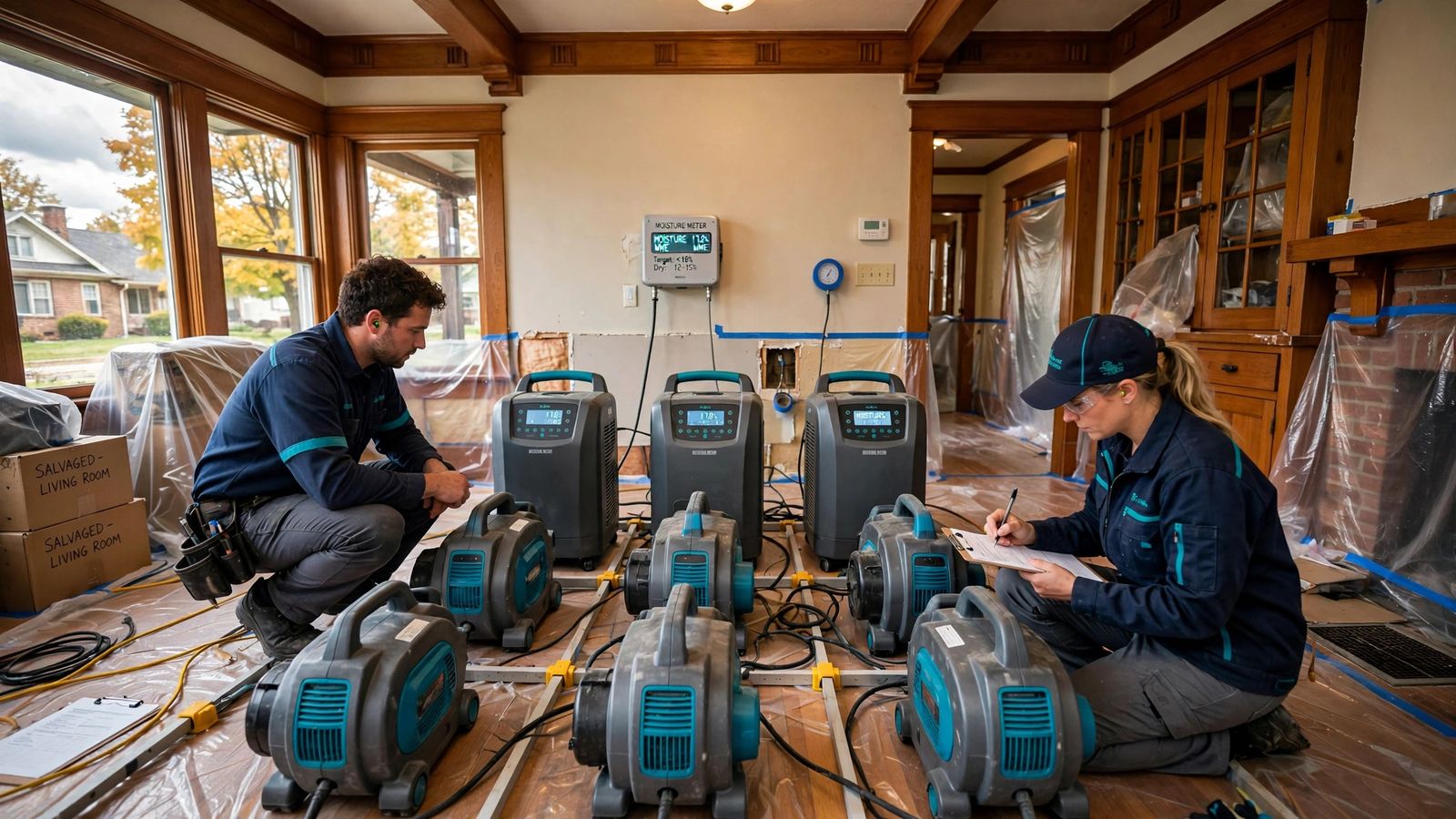
Structural drying and dehumidification uses industrial air movers and dehumidifiers, with daily moisture monitoring, to dry framing, subfloor, and drywall completely after water extraction — preventing the mold growth that follows incomplete drying. We handle this across Saint Joseph, Buchanan County, and the surrounding Andrew, DeKalb, and Doniphan County communities 24/7.
Signs You Need Structural Drying
Signs you need this
- ✓A room was recently flooded or had standing water removed
- ✓Walls, baseboards, or flooring still feel damp days after a leak
- ✓A musty smell lingers after visible water is gone
- ✓Paint or wallpaper is bubbling or peeling near a past water event
- ✓Your home or business just experienced any flooding or burst pipe
Why it happens
Even after standing water is extracted, moisture soaks into porous materials like drywall, subfloor, and wood framing — and without industrial drying equipment and real moisture monitoring, that trapped dampness commonly leads to mold within 24 to 48 hours, especially in enclosed spaces like basements and crawl spaces.
The Science Behind Structural Drying
Psychrometry, not just "running fans"
Effective drying depends on managing temperature, humidity, and airflow together — what restoration professionals call psychrometry. Air movers alone can actually slow drying if the surrounding air is already saturated with moisture; that's why dehumidifiers run alongside air movers rather than fans being used by themselves.
Why we monitor daily instead of guessing
We take moisture readings in affected materials daily using penetrating and non-penetrating moisture meters, comparing them against the unaffected "dry standard" readings taken elsewhere in the structure. Drying is complete when affected materials reach within a normal range of that dry standard — not on a fixed calendar schedule.
What equipment density actually means
IICRC guidance calls for a specific ratio of air movers to square footage and dehumidifier capacity to the amount of moisture being pulled from the air — under-equipping a room is one of the most common reasons DIY drying attempts fail and mold develops anyway.
How Structural Drying Works
Moisture mapping
We measure moisture levels in affected materials to establish a baseline and identify everything that needs drying.
Equipment setup
Industrial air movers and dehumidifiers are placed to maximize airflow and moisture removal.
Daily monitoring
Moisture readings are tracked daily, and equipment is adjusted as materials dry.
Confirmed dry
Drying is complete only once moisture readings return to normal, not just when things look or feel dry.
Water Damage? Get Proper Drying Started.
Skipping professional drying is the #1 reason mold shows up weeks later. 24/7 dispatch across the region.
Structural drying is usually priced per room per day of equipment runtime, not as a flat fee.
General ranges
| Item | Typical range |
|---|---|
| Structural drying, per room (3–5 days) | $500–$1,500 |
| Whole-floor drying setup | $1,500–$4,000 |
| Daily monitoring visit | Included in most drying packages |
General industry ranges, not a quote. Your price is set after an on-site assessment.
What drives the price
- ✓Number of rooms and square footage affected
- ✓How saturated materials were when drying began
- ✓Whether drywall/flooring removal sped up the process
- ✓Ambient humidity (worse during Missouri's humid summers)
Typical Drying Duration
Most residential structural drying jobs run 3 to 5 days with equipment operating continuously. Heavily saturated materials, finished basements, or drying during Missouri's humid summer months can extend this to 7 days or more. We don't pull equipment on a fixed schedule — moisture readings determine when a space is actually dry.
Why Missouri's Humidity Changes the Math
Saint Joseph's humid summers mean ambient moisture is already working against drying equipment for several months of the year, which is part of why we size equipment generously rather than minimally during that stretch. Winter drying, by contrast, benefits from naturally drier outdoor air but requires managing indoor heat to keep the drying process efficient without over-cooling the space.
Serving Saint Joseph, Buchanan County, and the surrounding Andrew, DeKalb, and Doniphan County communities
Tap a city below to confirm coverage, or call now for an assessment.
Other Ways We Can Help
Structural Drying Questions, Answered
How long does structural drying take?
Can I just use fans and skip professional drying?
Will my electric bill spike from running this equipment?
Get Your Drying Assessment
Damage assessment, 24/7 across the region. Call now.
Proudly serving Saint Joseph, Buchanan, Andrew & DeKalb County, and Doniphan County, Kansas as Pro St. Joseph Water Damage Restoration — find us on Google Maps.